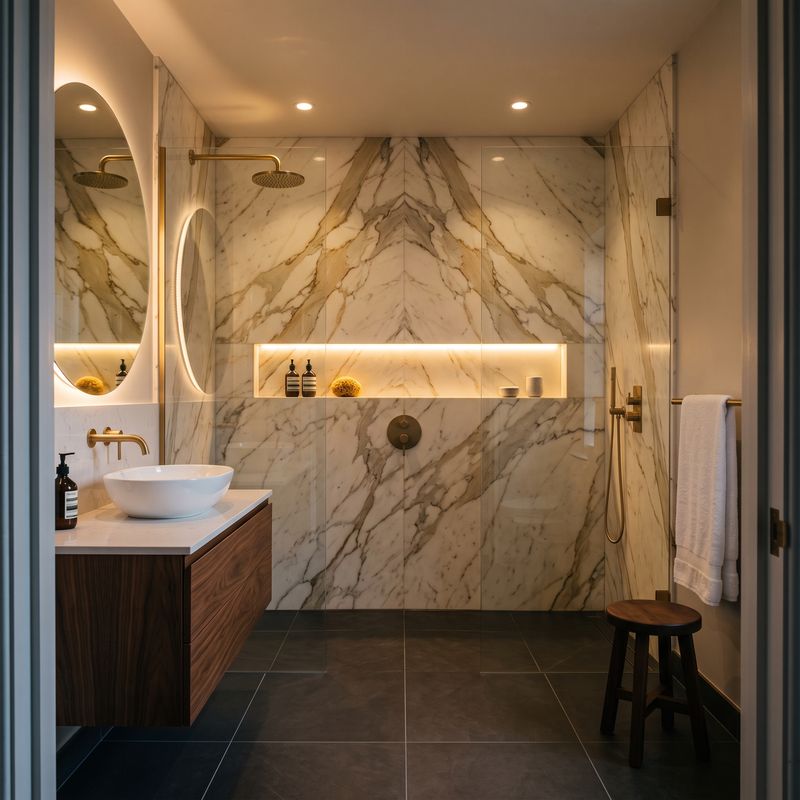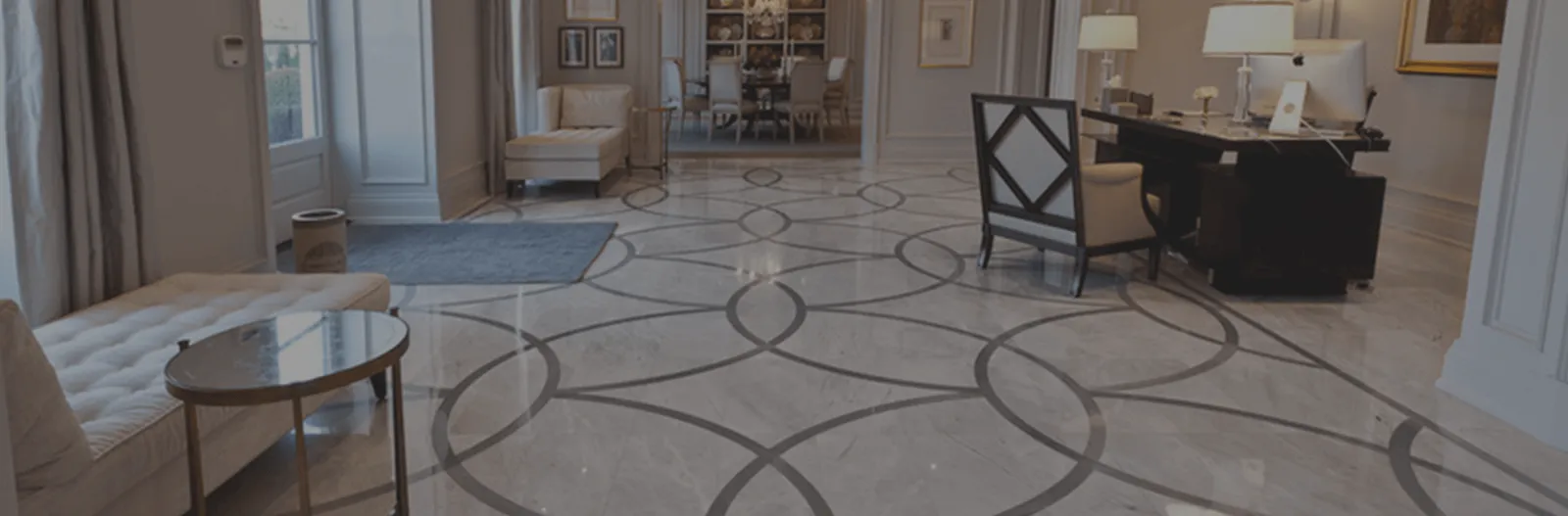
The short answer: in the North American tile standards, large-format tile means any tile with at least one edge 15 inches or longer. Think 12x24, 24x24, 24x48, long wood-look planks, and up to full porcelain slabs. It looks clean and modern with fewer grout lines. But big tile is rigid and unforgiving: it needs a very flat floor or wall, full mortar coverage and a setter who knows how to handle it, or you get lippage (uneven edges), hollow spots and cracks.
Large-format porcelain is a big part of what I install in Burlington, Oakville and Halton. Here’s what you should know before you buy it.
Why people love large-format tile
- Fewer grout lines: less scrubbing and a calmer, more expensive look.
- Small rooms feel bigger: walls and floors read as one surface.
- It runs everywhere: the same tile from the bathroom floor into a curbless shower with a linear drain.
- Great stone looks: marble-look and concrete-look porcelain shine at large sizes.
Why it’s harder to install than it looks
1. Flatness
Small tiles can follow small dips. Big tiles bridge them. If the floor has a hump, a 24x48 tile rocks on it; if it has a dip, the tile sits on its edges with a void underneath.
That’s why standards ask for tighter flatness under large-format tile. The industry guidance I follow (from the NTCA/ANSI material) is no more than 1/8 inch of variation in 10 feet and 1/16 inch in 24 inches for tiles with any edge 15 inches or longer. Getting a floor or wall there often means grinding, patching or self-leveling before tile. And no, thinset isn’t a floor leveller.
Remember: level and flat aren’t the same thing. A floor can slope perfectly and still be wavy. Tile cares about flat.
2. Warpage and lippage
Large porcelain tiles are rarely perfectly flat themselves; many have a slight bow in the middle. That’s why we:
- Keep offsets to a third on long tiles and planks instead of a 50% brick pattern, where the high middle of one tile meets the low end of the next. (Many makers specify this; check the box.)
- Use leveling systems to help keep edges even while the mortar sets.
But clips can’t fix a bad floor. They’re a helper, not a cure. That’s the whole point of Clip-and-Pray Lippage in our Tile NO’s series.
3. Mortar coverage
Big tiles need full support. The Ceramic Tile Education Foundation calls for about 80% mortar coverage in dry interior areas and 95% in showers, exteriors and natural stone, with edges and corners fully supported. On large tile, that usually means:
Ahh ahh ahh! Beware of cookie monsters. Pancake dots of thinset leave hollow spots behind the tile, so it cracks and pops loose. We back-butter and go for full coverage. Best way? Do your research and hire a pro.
- A large-notch trowel sized for the tile.
- Directional troweling: straight ridges, not swirls.
- Back-buttering: a thin, flat coat on the back of the tile.
- Sliding the tile across the ridges to collapse them.
- Pulling a tile now and then to check the coverage.
For large and heavy tile I use the mortar Laticrete lists for it: Laticrete MULTIMAX Lite (ANSI A118.15HET, where the “H” means large and heavy tile), which is also an approved mortar over Hydro Ban in showers. Regular-size porcelain gets Laticrete 254 Platinum. All of it goes on per Laticrete’s current installation instructions. The opposite is the cookie monster method: five dabs of mortar and a prayer. It’s fast, it looks fine on day one, and it sounds hollow by year two. (Pancake Pros & Cookie Monsters)
4. Cutting and handling
Large tile is heavy, flexes before it’s set, and can snap if you lift it wrong. Long cuts need the right saw and a steady hand. Holes for valves and drains need planning. On walls, big tiles need support while they set.
I get calls to finish large-format jobs that went sideways. Rui R. wrote in his Google review about a previous setter who had trouble cutting his 2x4-foot tiles, and I came in and finished the job. Paul F.’s review says I “rescue[d] a bathroom tile project that was botched from previous tiler.” It’s never that the tile was bad. It’s that big tile shows every shortcut. Flat substrate, full coverage, patience. That’s the recipe, every time.
Large-format tile in showers
On shower walls, large-format tile looks fantastic, as long as the walls are flat and the coverage is full. On shower floors, size depends on the drain:
- Linear drain: one-direction slope, so big tile can follow it.
- Centre drain: four-way slope, so big tile needs careful cuts, or use a mosaic on the floor.
Behind it all, my showers use a Laticrete Hydro Ban membrane over a custom-sloped cement mortar bed, never a foam pre-slope or tray, with no traditional liner pan. More in How to Choose Tile for a Shower.
Large-format vs porcelain slabs
Slabs are large-format taken to the extreme: big panels, often around 5x10 feet, with a seam or two instead of a grid. Everything above applies, times ten. See Porcelain Slab Showers.
Tips before you buy
- Check the floor first. Ask your installer how flat it is and what it’ll take to fix.
- Buy from one batch and check the shade/caliber on the boxes.
- Order extra for cuts and breakage.
- Ask about layout: where cuts land, offsets, and how it meets doorways and the shower.
- Preview it. Try a large-format look on a photo of your bathroom with the Bathroom Reno Visualizer.
Questions to ask your installer
- How flat is my floor, and how will you fix it?
- What trowel, thinset and coverage method will you use?
- Will you back-butter and pull a tile to check?
- What offset will you use on these tiles?
- Can I see in-progress photos of your large-format jobs? (Why ask)
Frequently asked questions
What size is considered large-format tile?
In the North American standards, any tile with at least one edge 15 inches or longer. So a 12x24 tile counts, because one side is 24 inches.
Is large-format tile good for small bathrooms?
Often, yes. Fewer grout lines make a small room feel bigger and calmer. Just plan the layout so you don’t end up with skinny slivers at the walls.
Why does my large tile floor have uneven edges?
That’s lippage. It usually comes from a floor that wasn’t flat, tile warpage combined with a 50% offset, or poor mortar coverage. Leveling clips help, but they can’t fix the floor underneath.
Can large-format tile go on a shower floor?
Yes, especially with a linear drain and a single slope. With a centre drain, it needs careful cutting, or you can switch to a mosaic for the shower floor.
Do I need a special installer for large-format tile?
You need someone who has done a lot of it and can show you how: floor prep, trowel and thinset choice, back-buttering and coverage checks. Ask for in-progress photos, not just finished ones.
See how large-format tile fits into our bathroom renovations.
Talk to Mike
Thinking about large-format tile or slabs in Burlington, Oakville or Halton? Call Mike at 289-337-1578 or book a consult. See our panel and large tile work on Slab Installations. Every job comes with a 25-year warranty on tile-setting workmanship.
Sources
- Laticrete MULTIMAX Lite data sheet (DS-328-1026), ANSI A118.15HET large & heavy tile mortar: cdnmdm.laticrete.com/Datasheet/NA/127/Datasheet_NA_en_127.pd
- Laticrete TDS 137, ANSI letters (H = Large and Heavy Tile); 254 Platinum listed A118.15E, not H: cdn-global.laticrete.com/-/media/project/laticrete-internati
- CTEF, coverage: ceramictilefoundation.org/blog/getting-coverage-needed-under
- NTCA/CUSTOM “Trowel and Error” (flatness tolerances): youtube.com/watch?v=Way5bMh-eYg
- ANSI A108 (large-format definition): blog.ansi.org/ansi/ansi-a108-a118-a136-2026-installation-cer
- TTMAC specifications (Canadian standard): ttmac.com/en/technical/specifications