
The short answer: pick a porcelain (or properly sealed stone) tile that’s rated for wet areas, use smaller or textured tile on the floor so your feet grip, match the tile size to the drain you’re using, and choose a look you’ll still love when it’s clean, not just when it’s in a showroom under perfect lights. The tile is the part you see. What’s behind it decides whether it lasts.
I’m Mike Bourdages. I build high-end showers in Burlington, Oakville and across Halton, and most tile regrets I tear out come from decisions made in a hurry at the store.
Start with the floor, because that’s where people slip
Shower walls are easy. The floor is where you need to think.
Grip comes from grout lines and texture
A shower floor gets wet, soapy and walked on barefoot. Two things give you grip:
- More grout lines. Small tiles and mosaics (think 2x2 or penny rounds) have lots of grout joints, and every joint is a little bit of traction.
- A textured or matte finish. Polished tile on a shower floor is a skating rink. Save polished for the walls.
Tile makers publish a wet slip-resistance number called DCOF. The ANSI A137.1 standard lists a minimum wet DCOF of 0.42 for level interior floors that get walked on wet. A shower floor is sloped and soapy, so treat that number as the floor, not the goal. Ask for the spec sheet and look for “suitable for wet areas” or “shower floor.”
Match the tile size to the drain
This is the one most people miss.
- Centre drain: the floor slopes down from all four sides, like a shallow funnel. Large tiles can’t bend to follow that, so they need smaller tile or careful “envelope” cuts.
- Linear drain: the floor slopes one way, like a ramp. That lets you run large-format tile (even the same tile as your bathroom floor) right into the shower.
If you’ve fallen for a big 24x48 tile and want it on the shower floor too, plan a linear drain from day one. The drains I install come from Shower Grate Shop, and the drain gets picked with the tile, not after it. More on that in the Complete Curbless Shower Guide.
Porcelain, ceramic or natural stone?
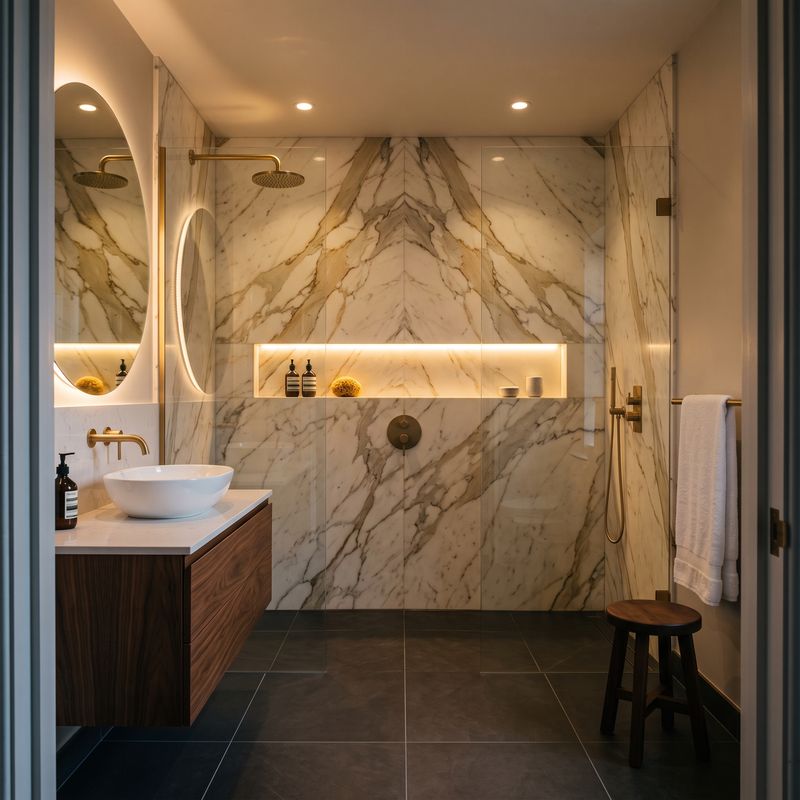
Porcelain is my default for showers. It’s dense, absorbs very little water (porcelain is defined in ANSI A137.1 as 0.5% water absorption or less), and the marble-look and stone-look versions today are honestly hard to tell from the real thing.
Ceramic is fine on shower walls. It’s softer and more absorbent than porcelain, so I don’t put it on shower floors. The porcelain vs ceramic guide goes deeper.
Natural stone (marble, travertine, slate) is gorgeous and every piece is one of a kind. It also needs sealing, gentle cleaners and more care. Marble etches with acidic cleaners and some shampoos. If you love it, go in with your eyes open, or use a marble-look porcelain and spend the difference on a lit niche.
When someone shows me a sample board of polished marble for the walls, the floor and the bench, I ask one question first: “Who’s cleaning it?” More often than not we end up keeping real stone on one feature wall, using a matte marble-look porcelain everywhere water sits, and nobody can tell which is which from the doorway. That’s the trick with stone: put it where it gets admired, not where it gets soaked.
Walls: big tile, slabs or something with personality
For walls, the big decision is how many grout lines you want to live with.
- Large-format tile (anything with an edge 15 inches or longer) means fewer lines and a calmer look. It needs a very flat wall and a setter who knows how to handle it. See What Is Large-Format Tile?
- Porcelain slabs take it all the way: floor-to-ceiling panels with a seam or two and no grout grid at all. Read Porcelain Slab Showers.
- Mosaics and patterns bring personality. A feature strip, a water-jet niche or a full mural like our ski chalet shower can make a small room the best one in the house.
Rectified edges and grout width
Rectified tile is ground to precise, square edges so it can sit with a tight grout joint. Non-rectified tile has softer edges and needs a wider joint. Don’t let anyone set a non-rectified tile with a hairline joint to “make it look rectified.” That’s how you get lippage.
Colour, veining and the “will I still like it” test
A few honest tips:
- Look at a full box, not one tile. Shade and veining vary.
- Dark floors show soap scum and hard-water spots. Halton water is hard. Mid-tones hide more than pure black or pure white.
- Pick grout colour on purpose. Matching grout makes tile read as one surface. Contrasting grout makes a pattern. Light grout on a shower floor needs more care.
- Think about the trim. Mitred corners (two tiles cut at 45 degrees) keep the veining wrapping around a niche or bench. Metal trim is cleaner and faster. Decide before you order.
- Try it on your actual bathroom. Upload a photo to our free Bathroom Reno Visualizer and see a concept before you buy a single box.
What’s behind the tile matters more than the tile
I’ll say it plainly: a great tile on a bad install is a bad shower. Every shower floor I build is a custom-sloped cement mortar bed, never a foam pre-slope or foam tray, with a Laticrete Hydro Ban membrane over it and no traditional liner pan. The drain is a drain compatible with Hydro Ban, per Laticrete and the drain maker’s instructions.
Why cement, not foam? Foam systems work when installed to their maker’s instructions. I prefer a bed I can slope by hand to the room, the drain and the tile, and with Laticrete 3701, wire mesh in the bed and rebar in the curb, it’s crazy over-built.
The other kind of installer is what I call a pancake pro: five blobs of mortar on the back of the tile and a prayer. It sounds hollow by year two. Meet the Pancake Pros and Cookie Monsters.
Questions to ask your installer before you buy tile
- Is this tile rated for a shower floor, and what’s the wet DCOF?
- Does my drain type work with this tile size?
- How flat are my walls and floor, and who flattens them?
- What waterproofing and thinset will you use with this tile?
- Will you mitre the corners or use trim?
Frequently asked questions
What is the best tile for a shower floor?
A matte or textured porcelain in a small format, like a 2x2 mosaic, is the safest all-round choice for a centre drain because the grout lines add grip and the small pieces follow the slope. With a linear drain, a textured large-format porcelain can work well. Always check the maker says it’s suitable for wet floors.
Can I use the same tile on the shower floor and walls?
Sometimes. If the tile has a matte, slip-resistant finish and you’re using a linear drain, running one tile through the whole room looks fantastic. If the wall tile is polished or very large and you have a centre drain, use a matching mosaic on the floor instead.
Is natural stone a bad idea in a shower?
No, but it’s higher maintenance. Stone needs sealing, pH-neutral cleaners and more care around acids. Many homeowners choose marble-look porcelain for the wet zones and real stone for a feature wall or vanity.
Do large tiles make a small shower look bigger?
Usually, yes. Fewer grout lines make walls read as one surface, which feels calmer and larger. The trade-off is that large tile needs flatter walls and more skill to install without lippage.
Should I pick tile before or after I hire an installer?
Ideally you shortlist a few looks, then talk to your installer before ordering. They can tell you if your drain, walls or layout will fight the tile you’ve chosen, and that conversation is free.
Choosing tile for a full bathroom renovation? See our bathroom work.
Talk to Mike
Planning a shower in Burlington, Oakville or anywhere in Halton? Bring your samples and I’ll tell you honestly what will work. Call Mike at 289-337-1578 or book a consult. Every job comes with a 25-year warranty on tile-setting workmanship.
Sources
- American Concrete Institute FAQ, air voids vs strength (~5% per 1%): concrete.org/frequentlyaskedquestions.aspx?faqid=657
- Laticrete 3701 data sheet (DS-100-1026), mixing: 2 to 3.2 quarts water per 60 lb bag for floor beds: cdnmdm.laticrete.com/Datasheet/NA/20/Datasheet_NA_en_20.pdf
- ANSI A137.1 (porcelain definition, DCOF): summarize, link TCNA publications page tcnatile.com/
- CTEF, coverage under tile: ceramictilefoundation.org/blog/getting-coverage-needed-under
- Shower Grate Shop (Shower Grate Shop Inc.), drain maker’s information and installation guidance: showergrateshop.com/ · FAQ: showergrateshop.com/support/faqs/ · Linear Drain Handbook: showergrateshop.com/linear-drain-handbook/
- Laticrete Hydro Ban installation instructions (DS 663.5): fabric only required over gaps larger than 1/8″, 72-hour cure for wet mortar beds before Hydro Ban, cure before flood testing, movement joints per TCNA EJ171 with backer rod and LATASIL: cdnmdm.laticrete.com/ProductAssets/Product%20Documents/ds663
- Laticrete Hydro Ban product data sheet (DS 663): cdnmdm.laticrete.com/Datasheet/NA/40/Datasheet_NA_en_40.pdf
- Laticrete 3701 Fortified Mortar Bed data sheet (DS-100-1026): 28-day compressive strength 5,000 to 6,000 psi (34.5 to 41.4 MPa), ASTM C270: cdnmdm.laticrete.com/Datasheet/NA/20/Datasheet_NA_en_20.pdf · product page: laticrete.com/products/3701-fortified-mortar-bed
- Laticrete TDS 196, Proper Trowel Selection and Back Buttering (key in, comb in one direction, back-butter, 95% coverage in showers per ANSI A108.5): cdn-global.laticrete.com/-/media/project/laticrete-internati