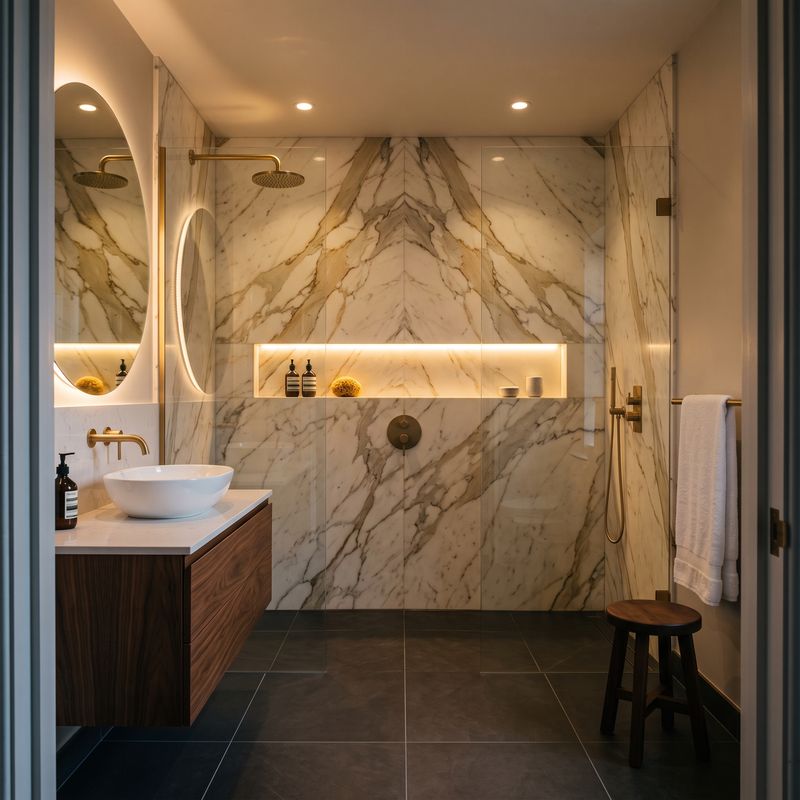
The short answer: most heated bathroom floors are electric: thin heating cables that sit under the tile, controlled by a thermostat with a floor sensor. They come three ways: pre-spaced mats, loose cables you lay out, or cables pressed into a heating membrane. All three work well when they’re installed and tested properly. The right one depends on your room shape, your subfloor and what else is going under the tile.
If you’re opening up your bathroom floor anyway, a heated floor is the comfort upgrade I recommend most. Ontario winters are long, tile is cold, and nobody regrets warm feet at 6 a.m. in February.
How electric floor heating works
A heating cable warms up when power runs through it, like a very long, very gentle toaster element. It sits just under the tile, so the heat goes straight into the floor. A thermostat on the wall reads a floor sensor placed between the cables and keeps the floor at the temperature you set.
It’s designed to make the floor comfortable, not usually to heat the whole room, although in a small bathroom it helps a lot.
The three main options
1. Heating mats
Cables come pre-attached to a mesh at a fixed spacing. You roll the mat out and embed it in thinset or self-leveler.
- Good for: simple, rectangular floors.
- Watch out for: odd shapes. Mats come in set sizes, and you can cut the mesh but never the cable.
2. Loose cables
A single cable you lay out by hand, usually held in place with strips or fastened to the floor, then covered.
- Good for: irregular rooms, around tubs, toilets and vanities.
- Watch out for: spacing has to be even and per the maker, and the cable must be fully covered and protected before tile.
3. Heating membranes
A plastic membrane with studs or channels that hold the cable at the right spacing. Many of these are also uncoupling membranes, which help isolate tile from small movement in the floor. Laticrete makes one (STRATA_HEAT), and other makers have their own systems. Mike to confirm which heated floor system(s) you install
- Good for: most bathrooms, flexible layouts, and floors where you want uncoupling too.
- Watch out for: thinset compatibility and coverage on both sides of the membrane, per the maker’s instructions.
What goes under a heated tile floor
From the bottom up, a typical build looks like this:
- Subfloor: solid, stiff and flat. A bouncy floor cracks tile, heated or not.
- Insulating underlayment (optional): on a concrete basement slab, it helps the heat go up into the tile instead of down into the concrete.
- Heating mat, cable or membrane with the cable laid at the maker’s spacing.
- Floor sensor between two runs of cable, never touching a cable.
- Thinset (I use Laticrete), applied for full coverage per Laticrete’s current installation instructions.
- Tile, grout and Laticrete LATASIL silicone.
Large-format tile works beautifully over heated floors, as long as the floor underneath is flat. Fred K.’s basement curbless shower used large-format tile with heated floors running through. (What is large-format tile?)
Testing: the step nobody should skip
A heating cable buried under tile can’t be fixed without lifting tile. That’s why every maker asks for the cable to be tested with a meter at several stages: out of the box, after it’s laid, and after it’s covered and tiled. Write the readings down and keep them. Many makers’ warranties depend on them. Mike to confirm your testing routine and whether you use a cable alarm/monitor during install
I treat a heating cable like a live animal under the floor. I test it before it goes down, while it goes down and after the tile is on, and I keep the numbers. The worst sound on a job is a nicked cable, so nobody walks on the mat in work boots, and nobody drags a bucket across it. If your installer can’t tell you what the readings were, ask them to test it again before you grout.
Thermostats and electrical
- Thermostat: programmable or Wi-Fi models let the floor warm up before you wake up and switch off when you leave. Mount it outside the wet zone.
- GFCI protection: floor heat in a bathroom needs ground-fault protection. Many thermostats include it.
- Circuit: small bathrooms may share a circuit; larger floors may need a dedicated one.
- Who connects it: electrical work in Ontario falls under the Electrical Safety Authority. Have a qualified electrician make the connection under an ESA permit. Mike to confirm how you coordinate the electrician on heated floor jobs
Heat in the shower and on the bench?
Some systems allow heat under a shower floor or on a bench, inside the waterproofing, and some don’t. It depends entirely on the maker. If you want a warm shower floor, choose a system that’s rated for it and plan the waterproofing around it. In my showers that’s a Laticrete Hydro Ban membrane over a custom-sloped cement mortar bed (never a foam pre-slope or tray), with no traditional liner pan.
Common mistakes
- Cutting the heating cable (never; cut only the mesh).
- Running cable under the vanity or toilet, where it does nothing useful or gets damaged by fasteners.
- Skipping the floor sensor.
- Not testing until after the tile is down.
- Thin, spotty thinset over the cable. Hollow tile over heat is still hollow tile. (Pancake Pros & Cookie Monsters)
Questions to ask your installer
- Which system do you recommend for my floor, and why?
- Will you test the cable at each stage and give me the readings?
- Where will the sensor and thermostat go?
- Who’s doing the electrical connection and the ESA permit?
- Is heat going into the shower floor, and is the system rated for it?
Frequently asked questions
Are heated bathroom floors worth it?
If the floor is already coming up, most people find it one of the best comfort upgrades in a renovation. It’s much harder to add later because it goes under the tile.
Can I add heated floors without replacing my tile?
Not with an in-floor system. The heat goes directly under the tile, so the tile has to come up.
Mat, cable or membrane: which is best?
None is best for every room. Mats suit simple shapes, loose cables suit odd layouts, and membranes give flexible spacing and often add uncoupling. Your installer should match it to your floor.
Do heated floors work under large-format tile?
Yes, as long as the floor is flat and the tile has full mortar coverage. Large-format tile and heat are a great combination.
Do I need a permit for a heated floor?
Electrical work in Ontario falls under the Electrical Safety Authority, so the electrician should take out an ESA permit. Building permits come from the City of Burlington and depend on the rest of your project. See our permit guide.
Talk to Mike
Want warm floors in your Burlington, Oakville or Halton bathroom? Call Mike at 289-337-1578 or book a consult. See more on our Bathroom Renovations page, and read Do I Need a Permit in Burlington? before you start. Every job comes with a 25-year warranty on tile-setting workmanship.
Sources
- City of Burlington (electrical permits via ESA): burlington.ca/en/building-and-renovating/do-i-need-a-buildin
- Electrical Safety Authority: esasafe.com/ (homepage responds; link homepage only)
- Laticrete STRATA_HEAT: laticrete.com/our-products/floor-heat (verified the product exists, Oct 17, 2026)
- Heated floor maker’s installation manual (Mike to name system)