Featured brand: LATICRETEThe company behind the materials in this story.

A better way than the full mortar bed
In the late 1940s, a young chemical engineer named Dr. Henry M. Rothberg was working in his family's floor covering installation business in South Carolina. The standard method back then was the "full mortar bed": a thick, heavy layer of sand and cement under every tile. It worked, but it was heavy and slow, and Rothberg was sure there had to be a better way.
So he went looking for one. Rothberg did development work with the U.S. Rubber Company (later Uniroyal Chemical) at its research facility in Naugatuck, Connecticut, studying synthetic latex that had been used in the concrete industry. The result was a liquid latex additive that could be mixed with ordinary sand and Portland cement. That made a strong, weather-resistant and shock-resistant mortar that could hold tile in a thin bed instead of a thick one.
The product was LATICRETE 4237 Latex Thin-Set Additive. LATICRETE calls it the first latex thin-set mortar in the industry. In 1956, the rubber company sold the LATICRETE brand to Rothberg, and LATICRETE International, Inc. was born. The company says it all began in a basement in New Haven, Connecticut.
So where does the name come from?
Here's how Mike explains it on the job: say it slowly. LATI for latex, CRETE for concrete. Liquid rubber plus Portland cement, right there in the name. It fits the story, too. The 2006 Congressional Record says the new latex "was introduced to the market as LATICRETE."
Selling thin-set to the world first
Here's the twist: North America didn't jump on it right away. Rothberg packed up samples and literature and took them overseas, where tile and stone were already common finishes. Big installations followed in Europe, the Middle East and Asia. For its early years, LATICRETE was mostly an export company.
Back home, he made his case to architects. If you get rid of thick, heavy mortar beds, a building needs less steel, less concrete and no depressed slabs. That argument stuck. The thin-bed method gradually became the normal way to set tile, and the modern adhesive mortars installers use every day grew out of that work.
From the World Trade Center to landmarks worldwide
As the thin-bed method spread, LATICRETE ended up on some very famous jobs. According to LATICRETE's own 2012 project newsletter, LATICRETE materials were specified in the construction plans for the original World Trade Center in New York. About twenty years later, the WTC's entire outdoor plaza was rebuilt with 150,000 square feet of granite paving, installed using the LATICRETE System.
After 9/11, LATICRETE was part of the rebuild too. At 1 World Trade Center, the tile contractor used a LATICRETE system that included HYDRO BAN waterproofing and crack isolation membrane, 254 Platinum polymer-fortified thin-set mortar, and LATICRETE grouts. They used it on 65,000 square feet of white marble wall tile in the lobby and sky lobbies, plus granite tile on the 64th floor.
In 2006, a tribute in the U.S. Congressional Record marking the company's 50th anniversary listed more landmarks built with LATICRETE products: the St. Louis Arch, the Detroit Renaissance Center, the Sears Tower, the Washington, D.C. Metro and the Petronas Twin Towers in Kuala Lumpur.
Always in the lab, still in the lab
LATICRETE is still family-owned, now into its third generation, and it supplies materials to more than 100 countries. The company says it grew from one U.S. factory exporting product into a worldwide network that offers local manufacturing, technical support and R&D.
That research habit shows up in our own trade. When 1 World Trade Center was being tiled, LATICRETE noted it was the first manufacturer of tile and stone installation materials to earn GREENGUARD certification for low-VOC products. Products like HYDRO BAN and 3701 Fortified Mortar Bed came out of the same tinkering that started with 4237. 3701 is a polymer-fortified mortar bed built for high flexural strength.


Waterproofing, the LATICRETE way
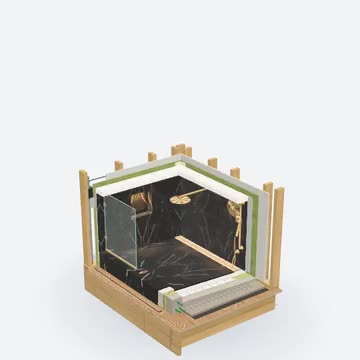
HYDRO BAN, LATICRETE's waterproofing and crack isolation membrane, was part of the system used to tile the lobby and sky lobbies at 1 World Trade Center. Burlington Tile builds its showers on LATICRETE waterproofing, behind every tile. Our step-by-step guide walks through sheet vs. liquid membranes, corners, seams and the flood test.
How to waterproof a showerNow they're printing houses
This is the part that surprises people. The company that invented a way to glue tile thinner is now making mortar that a robot can print into walls.
In 2019, LATICRETE announced it was investing in 3D printing mortar technology. It sponsored a 3D-printed concrete pavilion shell at Exhibit Columbus in Indiana, built with a prototype printable mortar, and tested its material with large-scale printers in Dubai.
Then it got real. The Fibonacci House, a small, livable and permitted home in the Regional District of Central Kootenay, British Columbia, was 3D-printed using LATICRETE 3D Printing Mortar M68. Its walls follow a spiral curve, not straight lines, and LATICRETE Canada says it was built in 11 days. Building officials accepted the printed mortar as leave-in-place formwork after the builders, working with the LATICRETE team, put together the mortar's strength, freeze-thaw, thermal and expansion data. LATICRETE Canada also said it became the first 3D-printed house listed on Airbnb.
In 2021, LATICRETE also said its M-68 3D mortar was being printed into the walls of a roughly 1,700 sq. ft. Habitat for Humanity home in Tempe, Arizona.
Why this matters for your bathroom
None of this means your shower is going to be 3D-printed. It means the mortars, membranes and grouts going behind your tile come from a company that has been doing serious materials research for 70 years and is still pushing it. That's why Burlington Tile builds with the LATICRETE system, from the mortar bed to the waterproofing to the grout, and backs the work with a 25-year warranty on tile-setting workmanship.
Building something solid?
See how we put this into practice, start to finish.
Bathroom Renovations Talk to us about your bathroomSources
- LATICRETE, History & Heritage: laticrete.com/about-us/company-overview/history-and-heritage
- LATICRETE, History of LATICRETE 4237 Latex Additive: laticrete.com/…/history-of-laticrete-4237-latex-additive
- LATICRETE, Company Overview timeline: laticrete.com/about-us/company-overview
- LATICRETE newsletter (2012), "1 World Trade Center": PDF
- Congressional Record, Nov. 14, 2006, LATICRETE 50th anniversary: govinfo.gov
- FloorDaily (Aug. 22, 2019), "Laticrete Investing in 3D Printing Mortar Technology": floordaily.net
- Building Design + Construction, "The Fibonacci House: A test case of 3D construction printing": bdcnetwork.com
- LATICRETE Canada on LinkedIn (Aug. 2021), Fibonacci House on Airbnb, built in 11 days: linkedin.com
- LATICRETE International on LinkedIn (July 2021), Habitat for Humanity home, Tempe AZ: linkedin.com
LATICRETE and the LATICRETE logo are trademarks of LATICRETE International, Inc. Logo shown for identification only.